

Mind mapping helps you visually organize complex non-fiction books by breaking down key concepts and their relationships. Start with the main idea at the center and branch out with subtopics using clear, concise phrases. Adding colors and icons can enhance understanding and retention. Keep your structure simple, limiting layers to avoid confusion. This technique not only improves clarity but also boosts retention, making it easier to grasp difficult material. There’s more to uncover on this method’s benefits.
Key Takeaways
- Begin with the book’s main idea at the center of your mind map for focused visualization.
- Identify and branch out key themes or concepts from each chapter to build a hierarchical structure.
- Use concise keywords to capture essential points, making it easier to recall information later.
- Incorporate colors and icons to enhance visual connections and categorize different ideas.
- Limit layers to four levels to prevent cognitive overload and maintain clarity in your mind map.
How to Create an Effective Mind Map
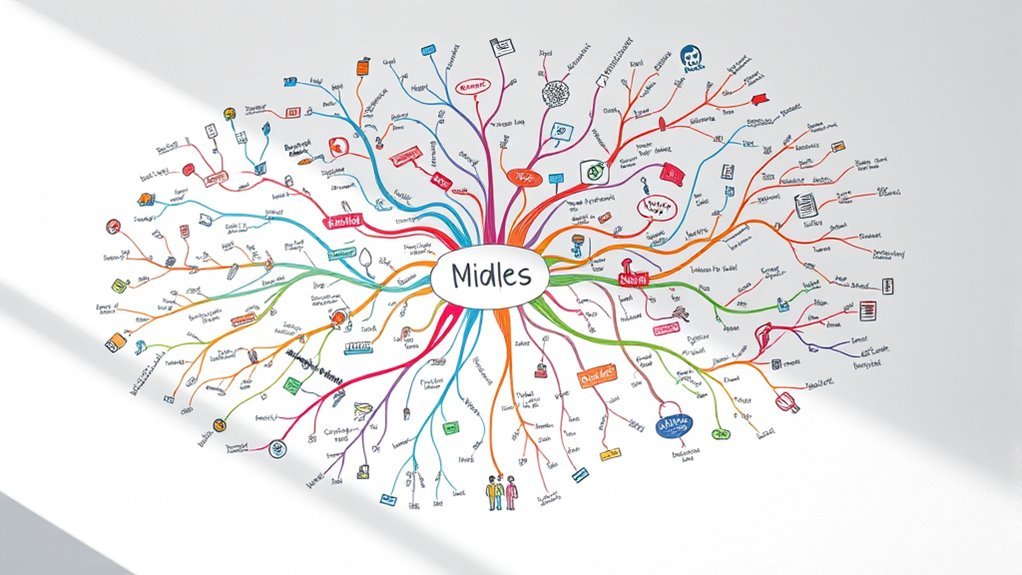
Creating an effective mind map starts with placing your central topic right at the center of your page or canvas. Use clear, succinct wording, selecting a single keyword or short phrase that encapsulates your main idea, like a project name or decision. From there, brainstorm supporting details freely, generating 3-5 main subtopics that branch outward. Don’t worry about order; just let your ideas flow, capturing them messily at first. Once you have your branches, create sub-branches with related concepts. Expand as needed, using short phrases to keep it concise. As you refine your structure, feel free to rearrange and visually enhance with colors or icons to make connections clearer and aid recollection. This process ensures that you can capture ideas and information effectively, leading to improved productivity and creativity. Additionally, applying techniques such as the Slow Reading Movement can further deepen your comprehension and engagement with the material you’re mapping. Engaging with texts through active reading strategies can significantly enhance your understanding and retention of complex concepts.
Key Concepts in Mind Mapping
Once you’ve laid out your mind map, understanding its key concepts is vital for maximizing its effectiveness. Start with a central idea that serves as your focal point, with branches radiating outward to capture related concepts. Use concise keywords at each node to maintain clarity. Organize your ideas hierarchically, placing significant elements closer to the center. Explore techniques like branching, which allows you to extend primary branches into sub-branches. Employ color-coding and images to enhance visual grouping and retention. Remember to chunk information into manageable groups to aid understanding. Additionally, integrating synthesizing information can bolster your comprehension as it encourages a deeper engagement with the content. Adopting a diverse reading habit can provide you with unique perspectives that enrich your mind mapping process. Finally, connect ideas through spatial positioning and lines to highlight relationships, ensuring your mind map is not just a collection of notes but a powerful tool for comprehension. Incorporating different types of mind maps can tailor your visual organization to specific tasks and enhance clarity.
Best Tools for Mind Mapping Success

Mind mapping can become a breeze with the right tools at your disposal. Here are some of the best options to enhance your mind mapping experience:
| Tool | Features | Pricing |
|---|---|---|
| Mapify | AI generator for documents and videos | Variable pricing |
| MindMeister | Real-time collaboration, easy to use | Free, with paid plans |
| ClickUp | Task generation from ideas | Starts at $8.25/month |
| Coggle | Beginner-friendly, loops, and branch joining | Free Forever plan |
| Miro | Infinite canvas, visual tracking | Free, with premium plans |
Experiment with these tools to find the right fit for your needs. Incorporating reflective practices can deepen your understanding while mind mapping. With advanced mind mapping software like ClickUp, you can merge project management and brainstorming into a single platform. Engaging in deep work can further enhance your effectiveness when using these tools. Happy mind mapping!
Transforming Information: Mind Mapping for Clarity and Retention
By utilizing mind mapping, you can transform complex information into clear, organized structures that enhance your understanding and retention. Scientific studies show you can increase retention by 10-15% using mind maps compared to traditional methods. The visual and spatial elements create a multi-sensory learning experience, helping your brain process information more deeply. When you use mind maps, you’ll likely recall information better even after a week, thanks to the brain’s preference for spatially organized data over linear text. This technique not only reduces cognitive overload but also allows you to see connections between topics clearly. Additionally, as with critical thinking, the ability to identify bias in the information can lead to a more thorough understanding of the material. Proper training in mind mapping can further amplify its effectiveness and facilitate deeper cognitive processing. Engaging with this technique can also reflect the principles of cultivating a digital garden, where interconnectedness fosters knowledge growth. By engaging with mind mapping voluntarily, you’ll improve your long-term memory performance and integrate knowledge across disciplines more effectively.
Achieving Structure and Depth in Your Mind Map

To effectively structure your mind map, start by establishing a clear central node that encapsulates the main theme of your book. This central idea acts as the focal point, triggering radial thinking and ensuring all branches connect back to the core theme. Next, develop primary branches that radiate from the center, identifying key concepts that represent major topics relevant to your book. Use the following guidelines for better organization:
- Define broad categories like acquisitions, production, and marketing.
- Break primary branches into sub-components for detail.
- Incorporate shapes and colors to enhance visual appeal.
- Limit your layers to four to prevent overcomplication. Mind maps can enhance access to stored facts and experiences, making the process even more effective. Additionally, employing techniques from the SQ3R method can aid in improving comprehension and retention of complex information. Understanding the unique emotional responses elicited by different genres can also provide deeper insights into the themes presented in your non-fiction text.