

To approach polity and governance for the Indian civil service, start with the historical evolution of the Constitution, focusing on foundational principles. Get familiar with key Fundamental Rights, which empower citizens. Understand the governance structures at Union and State levels, and explore the Panchayati Raj system’s role in local governance. Finally, grasp the importance of e-governance in enhancing accountability. By building on these concepts, you’ll gain a well-rounded perspective on governance in India.
Key Takeaways
- Understand the historical context of the Indian Constitution to grasp its foundational principles and reforms over time.
- Familiarize yourself with the Fundamental Rights to contextualize individual freedoms and their implications in governance.
- Study the governance structures at Union and State levels to comprehend the division of powers and roles of elected officials.
- Explore the Panchayati Raj system to recognize its significance in local governance and the challenges it faces in implementation.
- Stay updated on e-governance initiatives and current affairs to connect theoretical knowledge with practical applications in civil service.
Historical Evolution of the Indian Constitution

The historical evolution of the Indian Constitution spans several key phases that profoundly shaped India’s governance. It began with the East India Company Rule, marked by acts like the Regulating Act of 1773 and the Charter Act of 1833, emphasizing centralized administration and competition in civil services. Following this, the British Crown Rule saw significant legislative reforms, particularly the Government of India Act 1935, which laid the groundwork for a federal structure, although it was only partially implemented due to princely states. The Constituent Assembly, formed in 1946, played an important role in drafting the Constitution. After debates and revisions, the Constitution was adopted on 26 November 1949, finally coming into effect on 26 January 1950, establishing a thorough legal framework for governance. This Constitution was influenced by the Government of India Act 1935, which provided many foundational principles.
Key Fundamental Rights in Indian Polity and Governance
In understanding Indian polity and governance, it’s essential to grasp the key fundamental rights that shape citizens’ lives. You’ll find the Right to Equality, Right to Freedom, and Right to Constitutional Remedies serve as pillars of justice and protection against discrimination and exploitation. These rights not only empower individuals but also uphold the values enshrined in the Constitution. The fundamental rights, articulated in Articles 12 to 35, provide a framework that protects citizens from arbitrary actions by the state and ensures governance by law rather than by individuals.
Right To Equality
Equality forms the cornerstone of justice and fairness in any democratic society, and in India, the Right to Equality is enshrined in Article 14 of the Constitution. It guarantees that the state cannot deny equality before the law or equal protection of laws to anyone within its territory, including citizens, foreigners, and various social groups. This right is a negative concept, demanding the state abstain from discriminatory acts and denying special privileges based on status. The principles derived from both British and American law emphasize that everyone is treated equally under similar circumstances. Landmark judgments reinforce that Article 14 aims to eliminate arbitrariness and allows for reasonable classifications to promote substantive equality, particularly for historically disadvantaged groups. Furthermore, Article 14 empowers the State to actively bridge inequalities among citizens. Moreover, cultivating consistent reading habits can enhance critical thinking and improve our understanding of how laws apply to diverse scenarios, as reading regularly can serve as a cognitive shield against cognitive decline, enhancing our engagement with such concepts.
Right To Freedom
Building on the foundational principle of equality, the Right to Freedom forms an essential aspect of the Fundamental Rights guaranteed by the Indian Constitution. This right encompasses several freedoms, allowing you to live and express yourself within the framework of reasonable restrictions. Here’s a quick overview:
| Freedom | Description |
|---|---|
| Speech & Expression | Freedom to speak, demonstrate, and express ideas |
| Assembly | Right to assemble peacefully without arms |
| Association | Freedom to form unions or associations |
| Movement | Right to move freely and reside anywhere in India |
| Profession | Freedom to practice any occupation or trade |
These freedoms promote individual choices and collective actions, contributing to a vibrant democracy. Always remember, though, that these rights can be subjected to reasonable restrictions for public interest. Furthermore, these freedoms are enshrined as a Fundamental Right in Articles 19 to 22 of the Indian Constitution, ensuring protection against undue state restrictions. Engaging with literature can enhance your understanding of these concepts, offering insights into how continuous learning can influence one’s approach to governance and rights. The process of immersive storytelling reflects how narratives can help deepen our grasp of individual freedoms and their implications in society.
Right To Constitutional Remedies
The Right to Constitutional Remedies is often regarded as the cornerstone of Fundamental Rights in the Indian Constitution, ensuring that individuals have a pathway to seek justice when their rights are violated. Enshrined in Article 32, this right empowers you to approach the Supreme Court directly, which can issue various writs like habeas corpus and mandamus, safeguarding your fundamental rights. While Parliament may allow other courts to exercise writ powers, the Supreme Court remains the ultimate protector of these rights. Writs provide swift judicial intervention during emergencies, fundamental guarantees are critical in making your rights actionable. Remember, Article 32 provides quick access to justice, reinforcing that rights without enforcement hold little meaning.
Analyzing Union and State Governance Structures
Although it might seem straightforward, understanding the intricacies of union and state governance structures in India is essential for civil service aspirants. Here’s what you should focus on:
- Union Executive: The President is the nominal head, while the Prime Minister and the Council of Ministers hold real power.
- State Structure: States are led by a Governor (ceremonial) and a Chief Minister (real power), supported by state civil services. The Council of Ministers plays a crucial role in the functioning of state governments.
- Legislative Division: Powers are categorized into Union, State, and Concurrent Lists, with the Union having the final say in disputes.
- Union Territories: These are directly governed by the Union, with limited powers given to certain territories like Delhi and Puducherry.
Mastering these elements will help you grasp the complex governance framework in India.
Panchayati Raj’s Role in Enhancing Local Governance in India
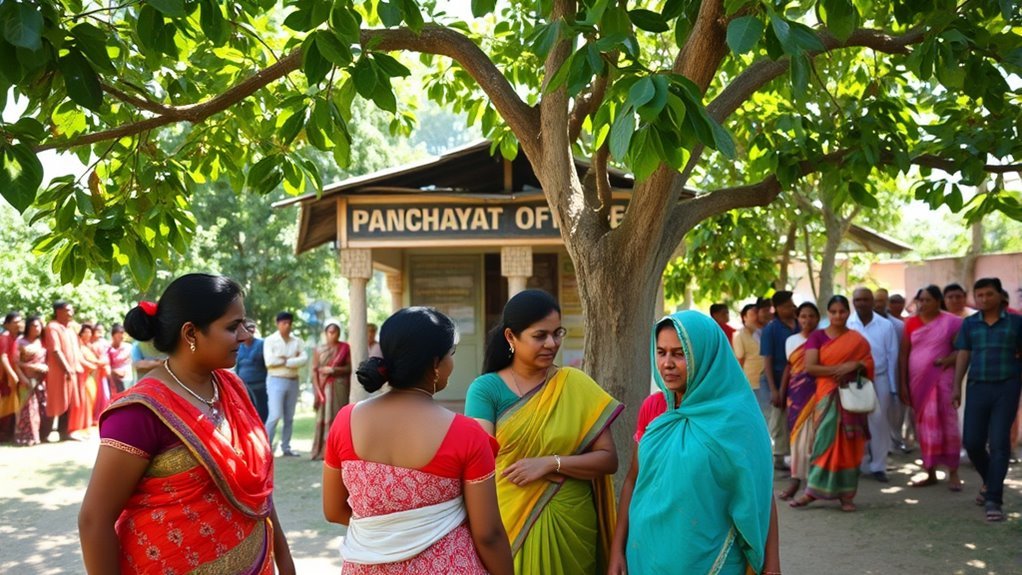
Panchayati Raj plays an essential role in strengthening local governance across India, ensuring that citizens have a voice in decision-making. However, there are challenges in its implementation that can hinder its effectiveness. By examining success stories, you’ll see how empowered local bodies can transform communities and address key issues effectively. The establishment of Panchayati Raj Institutions has formalized local governance, further enhancing the participation of rural communities in developmental processes.
Significance of Panchayati Raj
India’s local governance system greatly benefits from the Panchayati Raj, which empowers communities at the grassroots level. This system enhances local governance by fostering democratic participation and enabling decision-making through elected representatives. The significance of Panchayati Raj can be highlighted through the following points:
- Empowerment: It provides villagers with control over local resources and development.
- Decentralization: Authority is shared across three tiers—Gram Panchayat, Panchayat Samiti, and Zila Parishad—ensuring broad representation.
- Local Development: Focused on essential services like sanitation, education, and health, it addresses community needs directly.
- Community Participation: The Gram Sabha fosters engagement among villagers, enhancing transparency and accountability in governance. Furthermore, the 73rd Constitutional Amendment Act of 1992 established a three-tier structure that fundamentally empowers local self-governance.
These factors collectively strengthen democracy and improve the quality of life in rural areas.
Challenges in Implementation
While the Panchayati Raj system is designed to empower local governance, several challenges hinder its effective implementation. Financial constraints like inadequate funding from the State Finance Commission and reluctance to raise local revenues weaken panchayats. Additionally, a lack of devolution leaves many responsibilities unassigned, creating confusion. Bureaucratic hurdles, including overlapping jurisdictions and red tape, complicate operations, while capacity and training deficits prevent panchayat functionaries from fully utilizing schemes. It is essential to engage in critical thinking about how these challenges can be addressed, particularly in the context of transparency and accountability issues, such as fund misuse and caste-based politics, which further erode trust. Moreover, many Gram Panchayats are reluctant to generate their own source of revenue, limiting their financial independence and operational capabilities.
| Challenge | Description |
|---|---|
| Financial Constraints | Insufficient funds hinder panchayat activities. |
| Lack of Devolution | Less than 20% of states devolved all subjects. |
| Bureaucratic Hurdles | Red tape and confusion between jurisdictions. |
| Transparency Issues | Fund misuse and caste politics erode trust. |
Success Stories and Examples
Many success stories across the country showcase how the Panchayati Raj system has notably enhanced local governance. Here’s how it’s made a difference:
- Increased Representation: Post-73rd Amendment, SCs, STs, OBCs, and women have seen improved representation in local bodies, with women holding 37% of seats.
- Infrastructure Development: Initiatives led to better village infrastructure, such as electrification and improved roads, contributing to the enhancement of overall village infrastructure.
- Health and Education: Access to primary education and healthcare services, including ambulances in remote areas and better sanitation facilities, has greatly improved.
- Community Engagement: Local bodies, like Kudumbashree in Kerala, promote active participation in anti-poverty initiatives, ensuring that community needs are addressed efficiently.
These examples highlight the crucial role Panchayati Raj plays in strengthening local governance in India.
Enhancing Accountability Through E-Governance Integration

As e-governance continues to evolve, it plays an essential role in enhancing accountability within public administration. With India’s e-governance market projected to grow to USD 1,688.1 million in 2025, technological advancements empower citizens and streamline services. Initiatives like Digital India and the UMANG platform promote transparency and citizen participation, improving India’s EGDI ranking from 118th in 2014 to 97th in 2024. The inclusion of reference books supports informed decision-making and critical analysis among students and policymakers alike. Moreover, cultivating a digital garden fosters a personal knowledge management system, enabling individuals to connect related concepts for deeper understanding. Real-time dashboards and AI-driven tools enable data-driven decisions, while mobile governance solutions make public services accessible. Furthermore, Techugo’s commitment to completing 35 e-governance projects by FY26 aims to enhance governance and service delivery significantly. By minimizing paperwork and automating tasks, e-governance reduces administrative costs and increases efficiency. Overall, these developments not only fortify accountability but also enhance service delivery, creating a more responsive government for the citizens.
Connecting Current Affairs With Governance Topics
The evolving landscape of e-governance not only enhances accountability but also sets the stage for pressing governance topics in today’s context. By connecting current affairs with key governance issues, you can grasp the intricate dynamics at play. Here are four pivotal topics to reflect upon:
- Grievance Resolution: Platforms like PRAGATI streamline issue resolution between state and central governments. Creating a focus on optimal reading environments can also play a role in how stakeholders engage with the issues at hand.
- Legislative Accessibility: Proceedings in local languages deepen democratic engagement and transparency, while initiatives like AI/NLP tools ensure that legislative documents are more accessible to diverse populations. Additionally, fostering a conducive reading atmosphere enhances understanding of complex legislative texts.
- Decentralized Governance: The balance of power between local gram sabhas and bureaucratic institutions affects grassroots participation.
- Rural Development: Integrated farming approaches foster sustainability, aligning with broader national goals.
Understanding these connections will aid you in thoroughly engaging with contemporary governance challenges.