

Building a children’s home library on a budget is crucial for your child’s growth. Start with essential categories like board books, picture books, and early readers to develop their literacy skills. Look for used books at thrift stores or community sales, and don’t forget digital options like e-books. Aim for a diverse collection to guarantee your child sees themselves and others in the stories. Keep exploring to discover more tips for growing your library effectively!
Key Takeaways
- Start with a mix of board books, picture books, early readers, chapter books, and middle grade books for a well-rounded collection.
- Utilize local libraries, thrift stores, and community book sales to find affordable or free books.
- Explore digital resources like Project Gutenberg, LibriVox, and the Internet Archive for cost-effective eBooks and audiobooks.
- Focus on diverse literature to ensure representation of different cultures and experiences in your home library.
- Consider sharing and swapping books with friends and family to expand your library without extra costs.
Why Building a Children’s Home Library Matters
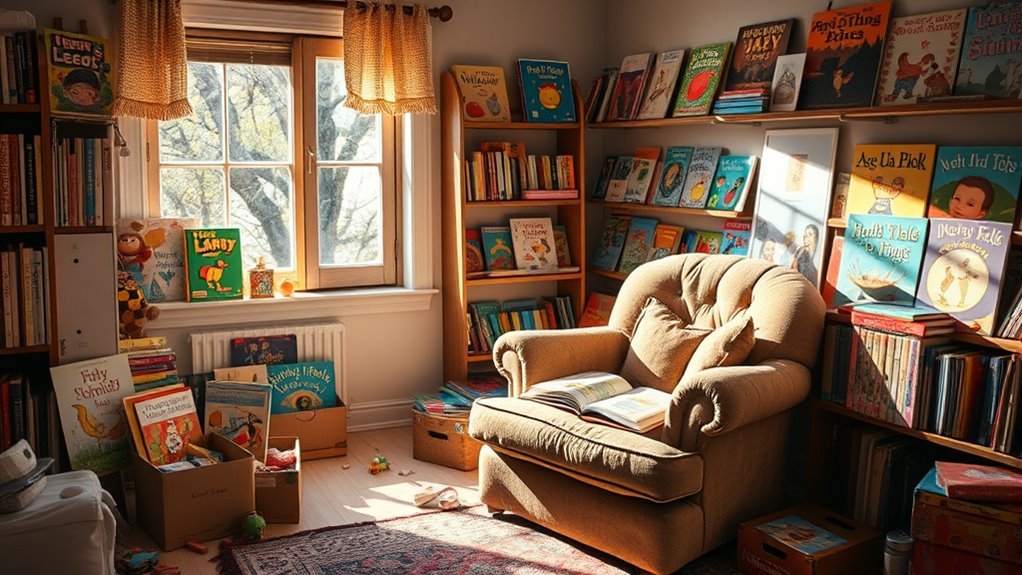
Building a children’s home library isn’t just a nice idea—it’s an essential tool for their future success. Access to books at home is linked to higher reading skills and greater educational attainment, often independent of parental backgrounds. When children grow up with 500 books, they can achieve over three additional years of schooling compared to those with few or none. Even having 20 books can create lasting positive effects on their future. Additionally, children without books face considerable learning losses, especially during breaks. A well-stocked home library greatly boosts literacy and cognitive development, making reading enjoyable and fostering a lifelong love for books. Furthermore, consistent reading serves as a cognitive shield against brain aging, ultimately enhancing their cognitive skills. Ultimately, investing in a home library sets the stage for lasting academic and personal achievement. Access to books combats learning loss during summer months, ensuring that children remain mentally active and engaged. Moreover, children who develop strong reading habits often exhibit heightened self-esteem and empathy, enriching their personal and social interactions.
How to Grow Your Library Without Breaking the Bank
Growing a home library on a budget is entirely possible with a bit of creativity and strategy. Start by exploring local libraries and school resources; they often provide free access to books for children. Consider purchasing used books from thrift stores or online platforms; many offer great deals. Look for community book sales, especially from schools or non-profits, where you can score fantastic titles at low prices. Additionally, don’t overlook digital options; e-books and audiobooks have gained popularity and can be much more affordable, with audiobooks emerging as the fastest growing format in books. Building a collection of books that supports a habit of regular writing can also enhance your child’s literacy development. Furthermore, creating a reading-friendly environment at home can spark your child’s interest in exploring new stories. Finally, share or swap books with friends and family to diversify your collection without spending extra money. With these approaches, you’ll create a rich library that fuels your child’s love for reading.
Discover Essential Book Categories for Young Readers

When it comes to curating a collection of books for young readers, you’ll want to investigate a variety of essential categories that cater to different age groups and reading levels. Start with board books for infants, featuring bright illustrations and simple concepts. As children grow, picture books introduce imaginative stories and emotional depth, which can significantly enhance language skills and foster a deeper connection with narratives, tapping into the psychology of genre as they learn to relate to different characters and situations. For those starting to read, early readers offer easy text and engaging illustrations, while chapter books provide short chapters that tackle adventure and friendship. Finally, middle grade books explore more complex plots, focusing on self-discovery and identity. Each category plays an important role in nurturing a love for reading and helping your child grow as a reader.
Top Places for Finding Cheap or Free Books
Where can you find cheap or even free books to enrich your home library? Start with Project Gutenberg, which offers over 77,000 free eBooks, including classics like *The Wonderful Wizard of Oz*. The Internet Archive Children’s Library boasts nearly 3,000 vintage stories, while LibriVox lets you listen to public domain books. For illustrated reads, check out Children’s Books Online or Free Kids Books for downloadable PDFs. Embracing the concept of an anti-library can inspire your choices and encourage future reading adventures.
Additionally, consider accessing content from the Internet Archive, which presents beautiful scans of original pages and illustrations for a richer reading experience.
Don’t forget about library-hosted digital collections! The Library of Congress and the International Children’s Digital Library have vast selections of scanned and free books. You can also explore specialized public domain sites like Timeless Truths or Storyline Online for unique resources. Your children can access countless stories without spending a dime!
Building a Diverse Collection: The Importance of Representation

After you’ve gathered a selection of affordable or free books for your home library, it’s time to contemplate the diversity within your collection. Inclusion matters; kids benefit from seeing themselves and others in stories. Currently, over half of children’s books feature significant BIPOC content, yet Black, Asian, and Indigenous representations remain lacking. While Black representation is at 16% and Asian representation is 13%, Indigenous voices are just 3%. It’s essential to choose books by BIPOC authors, as they provide authentic perspectives missing from many narratives. Additionally, books published in 2024 showed that 51% of titles included significant BIPOC content, highlighting the progress being made in children’s literature. Engaging with diverse narratives can lead to enhanced empathy, which is critical for children’s emotional intelligence. Don’t overlook stories featuring LGBTQ+ characters or those addressing disabilities. A diverse library enriches your child’s understanding of the world, fostering empathy and connection with others, and can enhance their capacity to understand and share feelings with those from different backgrounds by immersing them in diverse perspectives. Invest in varied stories to encourage inclusivity.