
The Bhagavad Gita is a 700-verse conversation between Prince Arjuna and Krishna, set on a battlefield inside the epic Mahabharata. It is short, but it has been translated hundreds of times, and each version reads very differently. Some are simple and poetic, some include long spiritual commentary, and some break every Sanskrit word down for study.
Here are the six English editions worth reading, what each one is like, and which reader it suits best.
As an Amazon Associate we earn from qualifying purchases. Prices change often, so check the latest price in each book box.
Quick picks
Eknath Easwaran
Clear modern English with short introductions to every chapter.
A.C. Bhaktivedanta Swami Prabhupada
Sanskrit, word meanings, translation and a full devotional commentary.
Stephen Mitchell
A beautiful verse translation you can read in an evening.
The 6 editions compared
| Translator | Style | Commentary | Best for |
|---|---|---|---|
| Eknath Easwaran | Clear, modern | Chapter introductions | First-time readers |
| Stephen Mitchell | Poetic verse | Short | Reading it as literature |
| Prabhupada (As It Is) | Devotional | Full verse-by-verse | Spiritual seekers, bhakti |
| Prabhavananda & Isherwood | Prose and verse | Light | A short, classic version |
| Paramahansa Yogananda | Yogic, in depth | Very detailed (2 volumes) | Yoga and meditation students |
| Winthrop Sargeant | Word-for-word | Grammar notes | Learning Sanskrit |
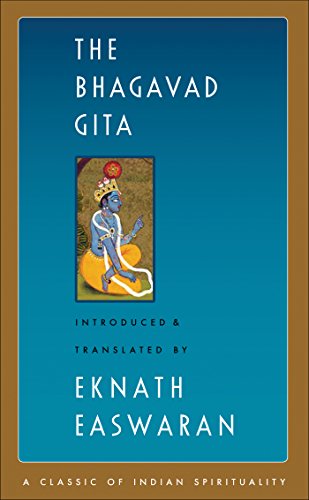
1. Eknath Easwaran (Nilgiri Press)
Easwaran was a respected meditation teacher who taught in both India and the United States, and his Gita is the one most often recommended to newcomers. The translation is simple, warm and easy to follow.
Each of the 18 chapters opens with a short introduction that explains what is happening and why it matters, so you never feel lost in unfamiliar ideas. There is also a longer introduction on the Gita’s background and a helpful glossary of Sanskrit terms. It does not include the Sanskrit text, so it is not for study of the original language. Skip it if you want verse-by-verse commentary from a particular tradition.
- Very easy to read
- Helpful chapter introductions
- Low price
- No Sanskrit text
- Light commentary
Edition shown: Nilgiri Press paperback.
Our verdict: The best first Bhagavad Gita for almost anyone.
2. Stephen Mitchell, Bhagavad Gita: A New Translation
Mitchell is a poet and translator known for his versions of classic spiritual texts. His Gita turns the dialogue into flowing English verse that is a pleasure to read aloud.
Because he focuses on beauty and clarity, the book reads quickly, and many readers finish it in one or two sittings. The introduction gives just enough background without weighing you down. The trade-off is that he takes some freedom with wording to make the English sing, so it is less literal than scholarly versions. Skip it if you want detailed explanations of each verse.
- Lovely, readable verse
- Short and inspiring
- Good gift
- Less literal
- Little commentary
Edition shown: paperback.
Our verdict: The best choice if you want to feel the Gita as poetry.

3. A.C. Bhaktivedanta Swami Prabhupada, Bhagavad-Gita As It Is
Prabhupada founded the Hare Krishna movement (ISKCON), and this is one of the most widely read Gitas in the world. Every verse comes with the Sanskrit, a transliteration, word-for-word meanings, a translation and a commentary.
The commentary, called a purport, explains each verse from the devotional (bhakti) tradition, with Krishna as the Supreme Lord. That makes it rich and complete for readers drawn to that path, and the word-for-word meanings are useful even if you do not share its view. It is a long book, and the commentary is clearly from one tradition. Skip it if you want a neutral or purely literary reading.
- Sanskrit, transliteration and word meanings
- Full verse-by-verse commentary
- Very affordable
- Commentary from one tradition
- Long and detailed
Edition shown: Bhaktivedanta Book Trust paperback.
Our verdict: The most complete study edition for spiritual seekers, especially in the bhakti tradition.

4. Swami Prabhavananda & Christopher Isherwood, The Song of God
This 1944 translation was made by a Vedanta monk and the English novelist Christopher Isherwood, and it comes with an introduction by Aldous Huxley. It has introduced generations of Western readers to the Gita.
The book mixes prose for explanation with verse for the most lyrical passages, which makes it smooth and easy to follow. It is short and inexpensive, so it is a good pocket edition. The style reflects the Vedanta view of the text, and some wording feels a little old-fashioned today. Skip it if you want the Sanskrit or detailed notes.
- Short and readable
- Introduction by Aldous Huxley
- Cheap paperback
- Slightly dated English
- No Sanskrit or notes
Edition shown: Signet Classics paperback.
Our verdict: A classic, compact Gita that is easy to carry and to read.

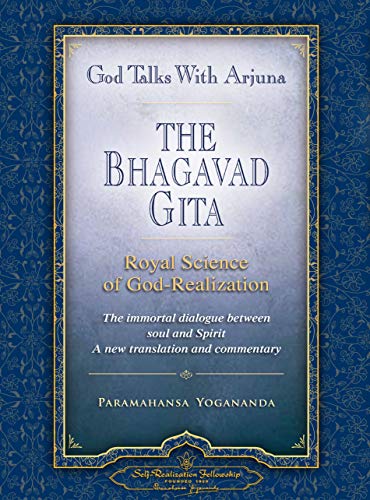
5. Paramahansa Yogananda, God Talks with Arjuna
Yogananda, the author of Autobiography of a Yogi, wrote a huge two-volume commentary that reads the Gita as a guide to meditation and the inner life.
Every verse is explained in depth, often with a symbolic reading in which the battle stands for the struggle inside each person. Readers who practise yoga or meditation find it deeply inspiring. It is long, more than a thousand pages across both volumes, so it is a book to study slowly rather than read straight through. Skip it if you want a quick read or a historical approach.
- Deep spiritual commentary
- Links the Gita to meditation
- Handsome two-volume set
- Very long
- Symbolic reading is Yogananda’s own
Edition shown: Self-Realization Fellowship two-volume set.
Our verdict: The richest choice for yoga and meditation students.
6. Winthrop Sargeant (SUNY Press)
Sargeant’s edition is built for readers who want to see how the Sanskrit works. Each verse is shown in Devanagari script, transliterated and broken down word by word with grammar notes.
A smooth English translation sits alongside, so you can read for meaning and then dig into the original as deeply as you like. It is an excellent tool for students of Sanskrit or anyone who wants to check other translations against the source. It is also the most expensive book here and not designed for casual reading. Skip it if you just want to read the Gita for inspiration.
- Word-by-word Sanskrit breakdown
- Grammar notes
- Great for checking other translations
- Expensive
- Not for casual reading
Edition shown: SUNY Press paperback.
Our verdict: The best Gita for learning Sanskrit or studying the original closely.

How to choose
Reading it for the first time?
Easwaran is the easiest start. Mitchell is a good second read if you love poetry.
Want guidance verse by verse?
Prabhupada for the devotional tradition, or Yogananda for a meditation-focused reading.
Want a short, portable copy?
Prabhavananda and Isherwood’s Song of God, or Easwaran.
Studying Sanskrit?
Sargeant’s word-by-word edition, perhaps alongside Prabhupada’s word meanings.
Want the full story around the Gita? See our picks of Mahabharata books and Ramayana books.
FAQ
Which Bhagavad Gita translation is best for beginners?
Eknath Easwaran’s. It is clear, short and explains each chapter before you read it.
Which edition has the Sanskrit text?
Prabhupada’s Bhagavad-Gita As It Is and Winthrop Sargeant’s edition both include the Sanskrit, a transliteration and word meanings.
How long is the Bhagavad Gita?
It has 18 chapters and about 700 verses. The text alone can be read in a few hours, but commentary editions run to hundreds of pages.
Is the Bhagavad Gita part of the Mahabharata?
Yes. It appears in the Mahabharata, just before the great battle of Kurukshetra.
Do I need a commentary?
Not to begin with. A clear translation is enough for a first reading. A commentary helps when you want to understand the deeper meaning of each verse.