
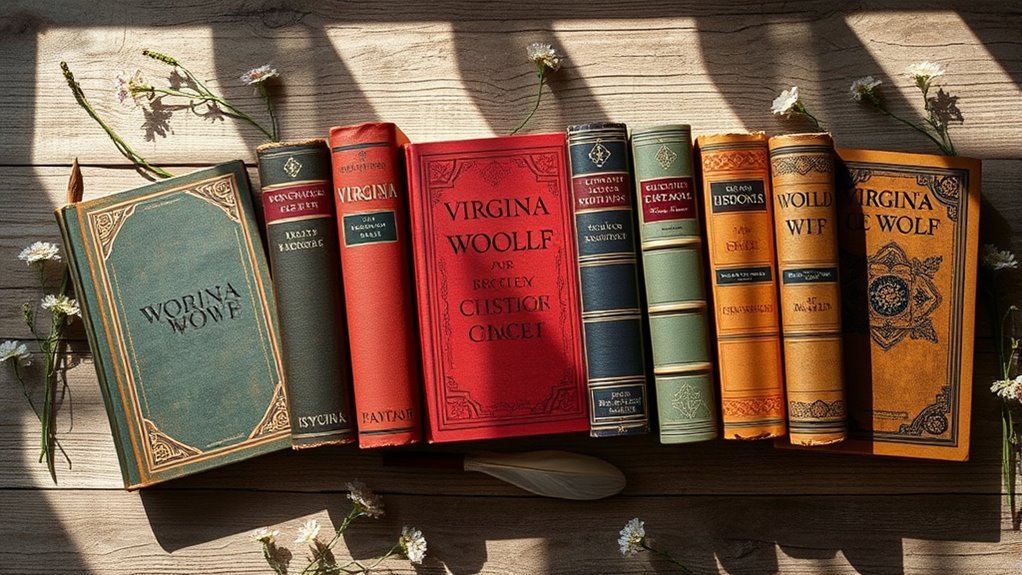
If you’re looking to explore Virginia Woolf’s essential works, start with *A Room of One’s Own* for its insights on women’s creativity. *Mrs. Dalloway* offers a deep look into identity and trauma, while *To The Lighthouse* beautifully examines time and memory. Don’t miss *The Waves*, which captures friendship and loss. Collections like *Virginia Woolf: Her Greatest Works* and authorized editions enhance your understanding. Many more gems await you, ready to illuminate Woolf’s literary brilliance!
A Room of One’s Own

Virginia Woolf’s “A Room of One’s Own” is a strikingly insightful essay that delves into the struggles faced by women in the literary world. Through the lens of an imagined sister to Shakespeare, who remains undiscovered and ultimately meets a tragic end, Woolf eloquently argues for the necessity of financial independence and personal space as essential for women’s creative flourishing. This work is a profound call for artistic freedom, emphasizing that without such autonomy, women’s voices are silenced.
Key themes include:
- The necessity of financial freedom for creativity
- The critique of societal barriers that hinder female expression
- The exploration of gender inequality in the arts, underscoring the need for women’s literary contributions to be recognized.
Woolf’s writing style is both lyrical and incisive, blending personal anecdote with a robust intellectual discourse. Her ability to navigate complex ideas with clarity makes “A Room of One’s Own” both accessible and thought-provoking. One can hardly forget her assertion that “a woman must have money and a room of her own if she is to write fiction,” which encapsulates her argument beautifully.
Ultimately, “A Room of One’s Own” is not merely a historical reflection; it resonates with contemporary issues of gender inequality and the quest for creative freedom. This essay is a must-read for anyone passionate about literature, as it inspires readers to recognize and challenge the persistent barriers faced by women in the arts, making it a timeless masterpiece that belongs on every bookshelf.
Virginia Woolf Collection 6 Books Set

The Virginia Woolf Collection 6 Books Set invites readers to delve into the intricate landscapes of identity, gender, and societal roles. In this captivating assortment, you’ll navigate the inner workings of Clarissa Dalloway’s thoughts in *Mrs Dalloway*, journey through time and gender with *Orlando*, and ponder the shifting perspectives in *To The Lighthouse*. Each work is a window into Woolf’s brilliant mind, reflected in the quest for self-discovery in *Voyage Out* and the passionate plea for a space in literature for women in *A Room of One’s Own*.
Key themes explored in this collection include:
- Identity and Self-Discovery: Woolf unravels the complexities of personal and social identities.
- Gender Norms: *Orlando* challenges the expectations placed on gender throughout history.
- Societal Roles: Her characters often navigate the rigid structures of their times, seeking freedom and understanding.
Woolf’s innovative narrative style, particularly her stream-of-consciousness technique, offers a profound and immersive reading experience. The lyrical quality of her prose is both poignant and evocative, drawing readers in as they reflect on life’s deeper meanings. As she pens in *Mrs Dalloway*, “She had the power to spread her arms and embrace the whole world,” illustrating her characters’ desire for connection and understanding.
This collection is an essential read for anyone interested in classic literature that marries emotional depth with social commentary. Virginia Woolf’s mastery of language and her ability to challenge conventional thought makes this set a treasure trove of insight, worthy of a spot on any bookshelf. Don’t miss the opportunity to engage with her timeless ideas that continue to resonate today.
Mrs. Dalloway: The Virginia Woolf Library Authorized Edition

*Mrs. Dalloway: The Virginia Woolf Library Authorized Edition* invites readers into a day in the life of Clarissa Dalloway, a socialite navigating the complexities of post-World War One London. Through an intricate web of thoughts and emotions, Virginia Woolf deftly explores themes of identity, societal expectations, and the profound impact of trauma, particularly as illustrated through the character of the veteran Septimus Warren Smith.
Key themes include:
- The interplay of consciousness and societal judgment
- The search for identity amid social constraints
- The enduring effects of war on individuals and their communities
Woolf’s signature stream-of-consciousness technique elegantly pulls you into the characters’ inner worlds, weaving their thoughts seamlessly and allowing for intimate insights. Her writing is both poetic and penetrating, with lines like “For there she was,” encapsulating the fleeting nature of existence and the weight of social roles.
Reading *Mrs. Dalloway* is not just about following a plot; it’s an immersive experience that challenges conventional storytelling with its profound emotional depth and rich characterizations. This is a novel that resonates deeply as it reflects on humanity, love, and the existential questions we face. If you’re ready to dive into a transformative literary journey, this essential read is sure to leave a lasting impression.
To The Lighthouse: The Virginia Woolf Library Authorized Edition

*To The Lighthouse: The Virginia Woolf Library Authorized Edition* offers an exquisite journey through the intricacies of human relationships and the inexorable passage of time. Divided into three interconnected sections, the novel delicately navigates the inner lives of the Ramsay family, revealing the profound depths of communication, isolation, and community. Woolf’s exploration prompts readers to reflect on the tangled web of human experience and emotional connection.
Key themes you can anticipate include:
- The essence of communication
- The tension between isolation and community
- The fluidity of time and memory
Woolf’s stream-of-consciousness style and rich, poetic language invite readers to lose themselves in her beautifully crafted prose. As she writes, “For nothing was simply one thing,” capturing the essence of the novel’s complex narrative structure. Her ability to weave multiple perspectives creates a rich tapestry of thought and feeling, making the internal struggles of each character palpably relatable.
This novel is not merely a read; it is an experience that resonates long after the final page is turned. Woolf’s introspective examination of life’s fragility and depth ensures that *To The Lighthouse* remains a timeless masterpiece worth exploring. Whether you’re a seasoned literature enthusiast or a curious newcomer, this book promises to challenge, engage, and transform your understanding of human connections. Don’t miss the opportunity to dive into Woolf’s world—it’s a journey that’s as enlightening as it is beautiful.
Virginia Woolf: Her Greatest Works

Virginia Woolf’s *To the Lighthouse* is a captivating exploration of the intricacies of time, memory, and human connections, set against the backdrop of a summer holiday on the Isle of Skye. Through the lens of the Ramsay family, Woolf weaves a poignant narrative that delves deep into the fluidity of perception and the enduring impact of relationships. This novel challenges readers to reflect on the ephemeral nature of life and art.
Key themes include:
- The fluidity of time and memory
- The complexity of human connections
- The impact of societal norms on personal identity
- The exploration of love and loss
- The inner lives and struggles of women
Woolf’s innovative stream-of-consciousness style invites readers into the intimate thoughts and emotions of her characters, creating a reading experience that is both reflective and immersive. Phrases like “For in the end, it is the moments that matter,” encapsulate the essence of her profound insights into human existence.
If you’re seeking a beautifully crafted narrative that invites contemplation and emotional depth, *To the Lighthouse* is a must-read. Woolf’s ability to intertwine complex themes with her distinctive voice not only sets her apart in modernist literature but also leaves a lasting impression on the heart and mind of the reader. This novel stands as a timeless exploration of what it means to be human, making it a valuable addition to any literary collection.
A Room of One’s Own: Collector’s Edition

In *A Room of One’s Own: Collector’s Edition*, Virginia Woolf explores the intricate relationship between gender and creativity through her iconic essay. By emphasizing the importance of personal space and financial independence, Woolf eloquently argues that freedom of thought and artistic expression is essential for women. This exquisitely illustrated edition not only enhances the themes of empowerment and gender equality but also immerses readers in Woolf’s profound reflections.
Main themes to consider:
- The necessity of a personal space for creative work
- Financial independence as a cornerstone for artistic freedom
- The historical challenges faced by women in literature
Woolf’s writing style is both lyrical and incisive, weaving together personal narrative and broader social commentary. Her prose captivates with its elegance and depth, encouraging readers to ponder difficult questions about identity and society. One memorable passage asserts, “A woman must have money and a room of her own if she is to write fiction,” capturing the essence of her argument in a way that resonates across generations.
This Collector’s Edition is not just a visual treat; it is a celebration of Woolf’s legacy, making it an essential addition for anyone who values insightful literature. With original illustrations and a detailed biography that further enriches the reading experience, this book is perfect for both display and deep contemplation. Whether you’re a devoted admirer of Woolf or discovering her for the first time, *A Room of One’s Own* is a thought-provoking read that invites you to reflect on the creative struggles faced by women and the significance of providing space for their voices.
The Waves

In “The Waves,” Virginia Woolf crafts a mesmerizing tapestry of six childhood friends—three boys and three girls—whose lives unfold against the backdrop of the sea. Through their intertwined experiences of friendship, love, and eventually, the heart-wrenching grief of losing Percival, Woolf invites readers to delve into the intricacies of human connection and the solitude that often accompanies it.
Key themes include:
- The interplay of unity and isolation in relationships
- The impact of loss and the journey through grief
- The deep reflections on identity and self-discovery
Woolf’s innovative narrative style is characterized by lyrical prose and a stream-of-consciousness technique, allowing readers to intimately experience the characters’ thoughts and emotions. As you navigate their internal landscapes, you may encounter lines that resonate deeply, such as, “I am made of the sea and the sun,” capturing the essence of human existence blending with nature.
For anyone seeking a profound exploration of life’s complexities, “The Waves” is an exceptional choice. Woolf’s ability to illuminate the inner workings of her characters amidst poetic lyricism positions this novel as a timeless masterpiece, compelling readers to reflect on their own emotional journeys. Don’t miss the chance to lose yourself in this extraordinary literary experience.
Factors to Consider When Choosing Virginia Woolf Books
When you’re picking a Virginia Woolf book, consider the themes and motifs that resonate with you. Think about her unique writing style and how it might affect your reading experience. Also, reflect on the importance of character development and the historical context behind her work to find a book that truly connects with you.
Themes and Motifs
Exploring the themes and motifs in Virginia Woolf’s works reveals a rich tapestry of ideas that resonate deeply with the human experience. You’ll encounter the fluidity of gender identity in *Orlando*, as the protagonist shifts through time and gender roles. In *To The Lighthouse*, the nonlinear passage of time highlights the complexities of human relationships. *Mrs. Dalloway* investigates mental health and societal pressures, showcasing the intertwining lives of Clarissa and Septimus, and the aftermath of trauma. Woolf also emphasizes the nuances of communication, along with the difficulties of expressing emotions. Finally, *A Room of One’s Own* champions the exploration of identity and creative independence, making it essential for anyone interested in women’s inner lives.
Writing Style Considerations
Virginia Woolf’s unique writing style greatly shapes how you experience her stories. Her use of stream-of-consciousness techniques immerses you in the inner thoughts and emotions of her characters. You’ll notice how her prose blurs the lines between poetry and narrative, creating vivid imagery and layered meanings that resonate deeply. Woolf’s non-linear narrative structure challenges traditional storytelling, inviting you to actively interpret the text. The fluidity of her language emphasizes identity, memory, and the complexity of relationships, urging you to explore profound philosophical questions. By focusing on psychological depth rather than plot, she allows for a rich exploration of character, making her works especially rewarding for anyone interested in the intricacies of the human experience.
Character Development Importance
Character depth is a cornerstone of Virginia Woolf‘s literary craft, drawing readers into the complex inner lives of her characters. You’ll find that she intricately develops each character to expose their thoughts, emotional conflicts, and struggles. For instance, in *Mrs. Dalloway*, the lives of Clarissa Dalloway and Septimus Smith showcase differing identities influenced by varied experiences. Woolf’s fluid narrative style in works like *To The Lighthouse* and *The Waves* allows you to explore multiple perspectives, enriching their character dynamics. The Ramsay family’s interactions reflect themes like isolation and communication, enhancing your understanding of human complexity. Woolf prioritizes characters’ internal experiences over traditional plot devices, fostering a deeper connection to their motivations and challenges.
Historical Context Impact
Understanding the historical context of early 20th-century Britain can enrich your reading experience of Virginia Woolf’s works. The societal shifts following World War I, particularly in women’s roles, deeply influence her themes of gender and identity. As a member of the Bloomsbury Group, Woolf engaged with progressive ideas about art and gender equality, which shaped her narratives. Her critique of traditional gender norms stems from the historical struggle for women’s suffrage, underscoring her advocacy for female creativity and independence. The modernist movement also plays a significant role, allowing her innovative styles to flourish. Woolf captures the zeitgeist of her era, reflecting the complexities of modern life and the psychological effects of changing social dynamics, especially on women.
Personal Relevance and Connection
When you choose a Virginia Woolf book, consider how her themes might resonate with your own life experiences. For instance, if you’re intrigued by gender identity, *Orlando* explores fluidity in a way that could reflect your beliefs. You might find a connection to the emotional depth in *Mrs. Dalloway*, especially if mental health and societal pressures speak to you. If you struggle with creativity and financial stability, *A Room of One’s Own* may mirror your challenges. Engage with the complexities of familial dynamics in *To The Lighthouse*, especially if you ponder existential questions. Finally, if you appreciate poetic language, *The Waves* uses innovative narrative techniques that enhance introspective character development, deepening your personal reflection.
Literary Influence and Legacy
Although you may be drawn to Virginia Woolf’s works for their lyrical beauty, it’s important to contemplate her literary influence and legacy as guiding factors. Her innovative writing style, especially the use of stream-of-consciousness, reshaped modernist literature and influenced future authors. Woolf’s exploration of identity, gender, and the inner lives of women provided significant commentary that transformed feminist discourse. Books like *Mrs. Dalloway*, *To The Lighthouse*, and *A Room of One’s Own* investigate the complexities of personal and collective identity, making them essential reads. Her critiques of societal expectations and advocacy for creative independence resonate today, securing her status as a pivotal figure in both literature and feminist movements. This enduring relevance is well worth considering when choosing her books.