
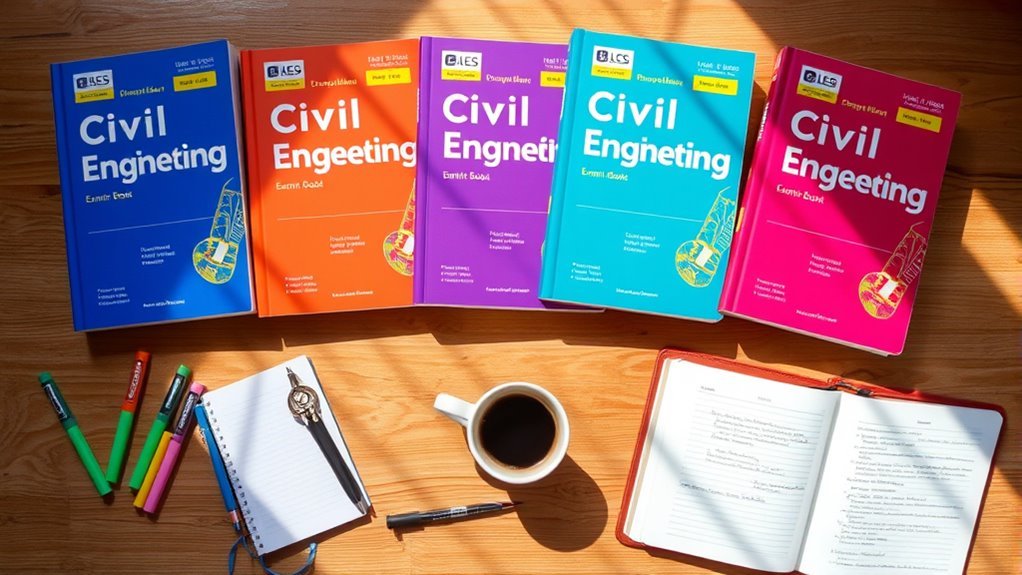
For the PE Civil Exam in 2026, check out the “Essential Guide to Water Resources,” “Essential Guide to Structural Civil,” and “Essential Guide to Passing Construction Civil” exams. These books cover key topics thoroughly, and they also include practical solutions. Don’t miss the “PE Civil Structural Exam Prep Study Guide” for practice problems, and the “PPI PE Civil Practice Problems, 16th Edition” for extensive practice. You’ll find crucial information essential for your success still ahead.
Essential Guide to Water Resources Civil PE Exam

Looking for a comprehensive study resource to ace the Water Resources Civil PE Exam? “The Essential Guide to Passing the Water Resources and Environmental Civil PE Exam” by Jacob Petro is a standout book that promises to elevate your exam preparation. This guide is meticulously crafted to align with NCEES Handbook methods, providing you with reliable content that rigorously adheres to the latest exam specifications.
Within its pages, you can expect detailed coverage on essential topics such as:
- Hydrology and hydraulics
- Water quality and treatment
- Environmental regulations and compliance
- Water resources management
- Stormwater management practices
The writing style is clear and approachable, making complex concepts more understandable with visual aids, detailed figures, and step-by-step solutions. This structure not only enhances comprehension but also promotes a practical approach to tackling real exam questions.
Essential Guide to Structural Civil PE Exam
If you’re an aspiring structural engineer looking to conquer the Structural Civil PE Exam, The Essential Guide to Passing the Structural Civil PE Exam is the perfect companion on your journey towards certification. This meticulously crafted guide features a robust collection of 160 CBT questions that directly align with NCEES Exam Specifications, ensuring you’re thoroughly prepared on crucial topics such as:
- Loads
- Material properties
- Component design
Each question comes with detailed explanations and alternate solutions, making it easier to understand complex concepts and improve your problem-solving skills. The writing style is straightforward and engaging, enhancing the reader’s ability to absorb the material while providing practical insights for real-world application.
In addition to its comprehensive content, the guide offers email support for any inquiries, making it an accessible resource for those navigating their exam preparation. For ambitious candidates ready to excel, this book stands out as a powerful tool that not only prepares you for the exam but also equips you with the confidence to approach varying difficulty levels with ease. Don’t miss the chance to elevate your study efforts—this guide could be the key to unlocking your success on the Structural Civil PE Exam.
Essential Guide to Passing Construction Civil PE Exam
The “Essential Guide to Passing Construction Civil PE Exam” is an indispensable tool for PE candidates in Construction Engineering. This resource is meticulously designed to align with the NCEES specifications, ensuring that you cover all the critical topics needed for exam success and fostering a deeper curiosity about the subject matter.
Key topics include:
- Essential concepts in construction engineering
- Vital knowledge areas relevant to the PE exam
- A diverse range of computer-based test questions
The writing style is engaging and organized, utilizing an active, question-based learning approach that promotes effective retention of information. This structure not only aids in understanding complex concepts but also boosts your confidence as you approach the exam day.
PE Civil Structural Exam Prep Study Guide

The PE Civil Structural Exam Prep Study Guide is an essential resource for aspiring civil engineers looking to pass the PE Civil Structural exam and elevate their professional careers. This comprehensive guide is packed with over 500 practice problems and 6 mock exams that target building codes, industry standards, and essential content from the PE Reference Handbook. With its organized study plan and detailed explanations, readers can easily navigate through complex concepts and identify areas for improvement.
Key topics covered include:
- In-depth understanding of building codes and standards
- Application of structural principles in real-world scenarios
- Strategies for tackling various problem types found on the exam
The writing style is clear and instructive, making complex information accessible and easy to digest. The structured approach fosters effective learning, breaking down extensive material into manageable sections that enhance retention and build confidence.
PPI PE Civil Practice Problems, 16th Edition

PPI PE Civil Practice Problems is a vital companion for any aspiring civil engineer gearing up for the NCEES PE Civil Exam. This resource features an extensive collection of over 900 practice problems designed to challenge and reinforce your understanding of key engineering concepts. With problems that span a wide array of topics such as:
- Soil mechanics
- Structural analysis
- Transportation design
this book promises to deepen your knowledge and enhance your exam preparedness.
The writing style is clear and direct, making complex concepts accessible to a variety of learning styles. Each problem not only tests your skills but also references the PE Civil Reference Manual, ensuring you become well-acquainted with the relevant codes and standards necessary for the exam.
Factors to Consider When Choosing PE Civil Exam Books
When choosing PE Civil exam books, you’ll want to evaluate several key factors. Look for the author’s expertise and credibility, as well as how extensive the content is. Don’t forget to check for practice questions, alignment with exam specs, and whether you’re getting good value for your money.
Author’s Expertise and Credibility
Choosing the right PE Civil exam book hinges greatly on the author’s expertise and credibility. Start by examining the author’s educational background and professional experience in civil engineering; this often signals their expertise in the subject matter. Look for authors who’ve published multiple works or contributed to respected textbooks and journals, as this reflects their commitment and authority in the field. Additionally, consider whether the author has firsthand experience with the PE Civil exam process, since those insights can be invaluable. Endorsements from industry professionals or educational institutions can further validate their credibility. Finally, assess any support they offer, such as being available for questions, which demonstrates their dedication to your success.
Comprehensive Content Coverage
To succeed in the PE Civil exam, you must guarantee the book you choose covers all necessary topics outlined in the NCEES exam specifications. Look for resources that encompass various question formats, such as multiple-choice and complex problems, to simulate the exam experience. Detailed explanations and solutions are essential, as they clarify concepts and reinforce your understanding of theories and applications. Select books featuring visual aids, like diagrams and figures, which facilitate better comprehension of engineering principles. Additionally, prioritize resources that emphasize current content reflecting the latest changes in design standards and codes relevant to civil engineering. Thorough coverage will equip you with the knowledge needed to excel on the exam.
Practice Questions and Solutions
In selecting PE Civil exam books, ensuring they feature a wide range of practice questions and solutions is essential for your preparation. Look for books that align closely with the NCEES exam format, incorporating both short, focused multiple-choice questions and complex, multi-step problems that integrate various engineering concepts. Choose extensive materials containing over 900 problems to deepen your understanding of key subjects. It’s vital that the practice questions come with step-by-step solutions and thorough explanations to clarify your thought processes and address knowledge gaps. Additionally, opt for guides that cover a variety of question types, including real-world scenarios referencing actual codes and standards, as this practice can greatly enhance your exam readiness.
Alignment With Exam Specifications
A solid grasp of the PE Civil exam‘s alignment with current specifications can make a significant difference in your preparation strategy. Confirm the books you choose are updated to reflect the latest NCEES exam specifications, as this guarantees alignment with testing standards. Look for materials that thoroughly cover the necessary topics outlined in those specifications. It’s crucial to select resources featuring detailed explanations and solutions that adhere to NCEES Handbook methods for accuracy. Structured question formats enhance retention and align with the exam’s problem-solving emphasis. Additionally, verify the content includes key design codes and standards specified by NCEES, as understanding these principles is fundamental for success on the exam.
Cost-Effectiveness and Value
Choosing the right PE Civil exam books should hinge on their cost-effectiveness and overall value. Evaluate each book’s affordability in relation to its breadth and depth of material covered. You want thorough content that doesn’t strain your budget. Many effective books provide cost-effective alternatives to expensive prep courses while adhering to NCEES exam specifications.
Look for resources with question-based formats and structured lessons, as these enhance retention and understanding, potentially reducing study time. Extensive practice problems are essential, offering valuable reinforcement at minimal cost. Additionally, consider books with supplementary resources like online platforms or extra materials, which greatly boost the value of your investment. Make sure you’re getting the most bang for your buck!
Accessibility and Support Resources
When selecting PE Civil exam books, considering accessibility and available support resources can greatly enhance your study experience. Look for books that offer supplementary materials like websites or platforms where you can dive deeper into the subject. Assess whether authors or publishers provide responsive support for your queries, making your learning process smooth. Visual aids, detailed figures, and real-world examples are essential for mastering complex concepts, so confirm these are included. Extensive feedback mechanisms, such as step-by-step solutions and thorough explanations, help clarify misunderstandings. Finally, check for the inclusion of practice problems or mock exams within the resources; these are invaluable for applying your knowledge and honing your exam-taking strategies effectively.
Questions
How Long Should I Study for the PE Civil Exam?
You should aim to study for about 3 to 6 months, dedicating around 15 to 20 hours per week. Consistent practice and reviewing key concepts will help you feel prepared and confident for the exam.
What Is the Format of the PE Civil Exam?
The PE Civil exam consists of 80 questions, primarily multiple-choice. Imagine tackling a question about structural analysis, applying your knowledge and reasoning skills to select the best answer in a four-hour time frame. You’ll manage your time wisely!
Are There Any Online Resources for PE Civil Exam Prep?
Yes, you’ll find plenty of online resources for PE Civil exam prep, including practice exams, video lectures, and interactive study guides. Websites like NCEES and various prep courses can really help you succeed.
How Can I Manage My Time During the Exam?
It’s easy to feel overwhelmed, but managing your time during the exam is essential. Prioritize questions, set time limits for each, and keep an eye on the clock. Stay focused, and you’ll maximize your performance.
What Is the Pass Rate for the PE Civil Exam?
The pass rate for the PE Civil exam typically ranges between 50% to 70%. It varies each year based on candidate preparedness and exam conditions, so focus on effective study strategies to improve your chances.