

Understanding economic systems helps you see how societies manage resources. You’ll discover capitalism, where private ownership thrives, and socialism, focusing on public goods and central planning. Mixed economies combine both approaches, balancing market regulation with social welfare. Traditional economies, driven by community needs, operate on bartering and sustainability. You’ll also find various ownership models, like cooperatives and partnerships, affecting innovation and stability. Keep going, and you’ll uncover even more insights into how these systems work!
Key Takeaways
- Economic systems include capitalism, socialism, and traditional economies, each with unique ownership models and decision-making processes.
- Capitalism emphasizes private ownership and profit motives, while socialism focuses on public ownership and planning for societal needs.
- Traditional economies prioritize self-sufficiency and community-based decision-making, using bartering rather than currency.
- Mixed economies combine market-driven capitalism with government intervention to address market failures and provide public goods.
- Understanding the characteristics and impacts of various economic systems can enhance one’s grasp of global economic dynamics.
Key Features of Capitalism, Socialism, and Other Economic Systems

When you explore economic systems, you’ll quickly notice that capitalism and socialism represent two contrasting approaches to ownership and resource allocation. In capitalism, private ownership of production means individuals or firms own resources, driving decisions through profit motives and competitive markets. This allows consumer preferences to dictate production and encourages innovation. On the other hand, socialism involves public ownership, with central planning determining resource allocation based on societal needs and income equality. Here, profit motives shift toward social welfare. Other systems, like feudalism or mercantilism, have their distinct features but usually hinge on ownership or state control. Understanding these key characteristics helps you grasp how each system influences economic behavior and societal outcomes. Many economists emphasize that capital accumulation for profit is a crucial element of capitalist systems.
The Government’s Role in Mixed Economies
Although mixed economies combine elements of capitalism and socialism, the government’s role is essential in balancing the needs of both the market and society. It regulates markets to correct failures, protects consumers, and enforces anti-trust laws to promote competition. The government also provides public goods like education and healthcare, funded through taxes. Its policies aim to redistribute income, using progressive taxation to support welfare programs for the less fortunate. Additionally, it stabilizes the economy through fiscal measures, addressing economic fluctuations. By balancing private enterprise with public welfare, the government encourages both competition and innovation, ensuring that essential services remain accessible while maintaining a fair market environment. Mixed economies aim for a balance between economic choices for citizens and government intervention to support necessary services.
Understanding Traditional Economies: Characteristics and Locations?
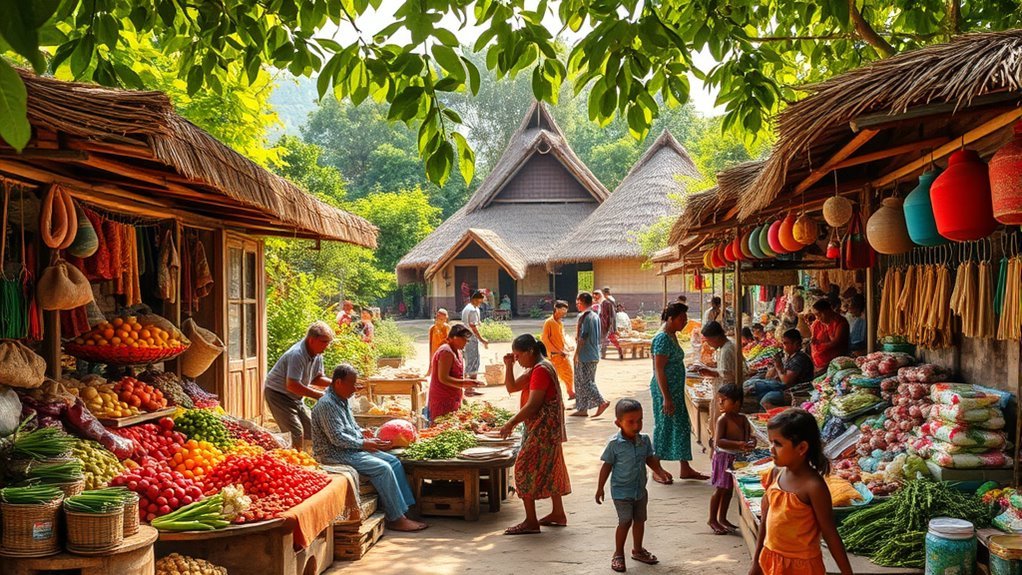
Traditional economies, deeply rooted in customs and cultural heritage, operate on principles distinct from modern economic systems. They prioritize self-sufficiency, focusing on producing goods for personal consumption and community needs. Decisions are often made by elders or family heads, reinforcing social hierarchies and ensuring stability. These economies rely heavily on bartering, where goods and services are exchanged without monetary transactions, fostering strong community bonds. Every member plays an essential role, with skills passed down through generations, creating a tightly-knit social framework. The use of simple tools and methods, like agriculture and hunting, aligns with local geography, promoting sustainability. Traditional economies thrive on local resources, minimizing waste and reducing reliance on external influences. Economic roles are assigned based on age, gender, and social status, which fosters belonging and mutual support among members. This emphasis on community engagement mirrors the benefits of lifelong reading, which also promotes strong cognitive functions and interpersonal understanding.
Examples of Traditional Economies Around the World
Have you ever wondered how traditional economies function in different parts of the world? These economies thrive through shared traditions and community reliance. Here are some examples:
- Maasai People: Nomadic cattle herders in Kenya and Tanzania, relying on livestock for subsistence and a barter system.
- Inuit Tribes: Inhabitants of northern Canada and Alaska, depending on hunting and communal sharing in harsh Arctic conditions.
- Amazonian Tribes: Indigenous groups in Brazil living off the land, focusing on gathering and hunting, with limited market interaction.
- Haitian Rural Population: Around 70-75% engage in subsistence farming and local exchanges, primarily using barter.
- Trobriand Islanders: Utilize the Kula Ring trade system, emphasizing social bonds through ceremonial gift exchanges.
How Different Ownership Models Affect Economies

Understanding how different ownership models affect economies is essential, as these structures shape the way resources are allocated and wealth is distributed. In private ownership, individuals or groups seek profit, driving innovation and decentralizing decisions. State ownership prioritizes public benefit and stability in key sectors, but it may introduce inefficiencies through bureaucratic control. Cooperatives empower members with democratic control, fostering equitable profit sharing and resilience. Social ownership models distribute control among workers or the community, creating a system that encourages participation and shared prosperity. Partnerships, whether general or limited, allow for pooled resources but can carry risks depending on liability structures. Ultimately, the choice of ownership model influences economic dynamics, balancing efficiency, stability, and equitable distribution to suit varying societal goals. Understanding these distinctions equips you to better grasp the complexities of modern economies.