
Homer’s Odyssey follows Odysseus on his ten-year struggle to get home after the Trojan War, past the Cyclops, Circe, the Sirens and the suitors waiting in his palace. The Greek original is a poem of about 12,000 lines, and every English translator has to choose between being faithful, poetic or simply easy to read. That choice changes the experience completely.
Here are the seven Odyssey translations worth reading, how each one feels and which reader it suits best.
As an Amazon Associate we earn from qualifying purchases. Prices change often, so check the latest price in each book box.
Quick picks
Emily Wilson
Clear, fast and exactly as long as the Greek. Great for first-time readers.
The 7 translations compared
| Translator | Year | Style | Best for |
|---|---|---|---|
| Emily Wilson | 2017 | Plain, rhythmic verse | First-time readers |
| Robert Fagles | 1996 | Grand, flowing verse | Epic feel |
| Richmond Lattimore | 1967 | Literal verse | Students of Greek |
| Robert Fitzgerald | 1961 | Poetic | Poetry lovers |
| Stanley Lombardo | 2000 | Punchy, modern | Reading aloud |
| Peter Green | 2018 | Scholarly verse | Readers who want Homer’s rhythm |
| E. V. Rieu (revised) | 1946 | Prose | Reading it like a novel |
1. Emily Wilson (Norton)
Wilson’s 2017 version was the first English translation of the Odyssey published by a woman, and it became a surprise bestseller. She uses clear, modern language and matches Homer’s poem line for line.
Her verse moves quickly and reads naturally, so the story pulls you along. She also rethinks words earlier translators softened, which makes slaves, servants and women feel more real. The introduction and notes are excellent for newcomers. Some readers miss the grandeur of older versions. Skip it if you want a lofty, old-fashioned epic voice.
- Clear and fast to read
- Same length as the Greek
- Excellent introduction
- Less grand than Fagles
- Some modern word choices divide readers
Our verdict: The best Odyssey for most first-time readers today.

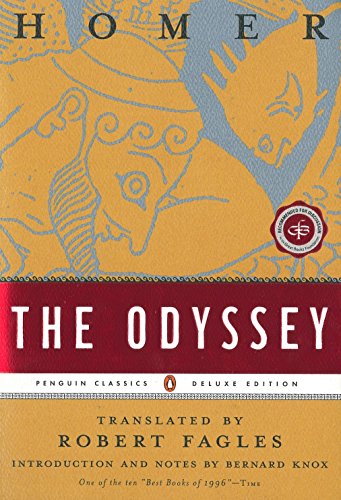
2. Robert Fagles (Penguin Classics)
Fagles’ translation has been a classroom favourite for decades. His flowing, dramatic verse gives the poem a true epic sweep, and the edition includes a famous introduction and notes by classicist Bernard Knox.
The language is modern enough to follow easily but grand enough to feel like Homer. Battle scenes, storms and the slaughter of the suitors are especially powerful. It is a little freer than Lattimore and a little longer than the Greek. Skip it if you want a strictly literal version.
- Epic, powerful verse
- Bernard Knox’s introduction
- Widely taught
- Freer than literal versions
- Longer than the Greek
Our verdict: The classic choice for an exciting, grand Odyssey.
3. Richmond Lattimore (Harper Perennial)
Lattimore stays as close to Homer’s Greek as English allows, keeping repeated phrases, epithets and long six-beat lines.
That makes it ideal for students who want to know what Homer actually wrote or who are learning Greek. The trade-off is that the English can feel stiff and unusual in places. Many readers pair it with a smoother translation. Skip it if you want an easy, flowing read.
- Very faithful to the Greek
- Keeps Homer’s repetitions
- Great for study
- Stiff in places
- Slower to read
Our verdict: The best Odyssey for close study.

4. Robert Fitzgerald (Farrar, Straus and Giroux)
Fitzgerald was a poet, and his 1961 translation is admired as a work of English poetry in its own right.
His verse is musical and inventive, and many readers who grew up with it still call it their favourite. He spells Greek names in a style closer to the original, which can surprise newcomers. It has fewer notes than Penguin or Norton. Skip it if you want lots of explanation alongside the text.
- Beautiful poetry
- Much loved classic
- Affordable
- Unusual name spellings
- Few notes
Our verdict: The best Odyssey for lovers of poetry.

5. Stanley Lombardo (Hackett)
Lombardo wrote his translation to be performed, and it shows. The lines are short, punchy and modern, so the story moves like a spoken tale.
It is a favourite in classrooms where students read aloud, and it is very easy to follow. Some readers find the plain, casual tone loses the poem’s dignity. Skip it if you want a formal, elevated style.
- Fast and lively
- Great for reading aloud
- Easy for students
- Very casual tone
Our verdict: The liveliest Odyssey for performance and class.

6. Peter Green (University of California Press)
Green, a respected classicist, keeps close to Homer’s meaning and tries to echo the six-beat rhythm of the Greek line, with a thorough introduction and notes.
It sits between Lattimore’s literal style and Fagles’ freer one: accurate, but still readable as poetry. The notes are especially useful for readers who want background on myth and history. It is less widely taught than Wilson or Fagles. Skip it if you want the most famous version.
- Accurate and rhythmic
- Detailed notes
- Modern scholarship
- Less known
- Long lines can feel heavy
Our verdict: A great choice for readers who want accuracy and rhythm together.

7. E. V. Rieu, revised by D. C. H. Rieu (Penguin Classics)
Rieu’s prose translation was the very first Penguin Classic in 1946 and has introduced millions of readers to Homer. It tells the story as a straightforward novel rather than a poem.
If verse puts you off, this is the easiest way into the Odyssey. The revised edition updates the language and adds helpful notes. You lose the poetry and rhythm of the original. Skip it if you want to experience Homer as verse.
- Reads like a novel
- Very easy to follow
- Historic Penguin Classic
- No poetry
- Less faithful in feel
Our verdict: The best Odyssey for readers who prefer prose.
How to choose
Reading it for the first time?
Emily Wilson for clarity, or Robert Fagles for epic grandeur.
Studying Greek or classics?
Lattimore for closeness, Peter Green for notes and rhythm.
Love poetry?
Robert Fitzgerald.
Not a fan of verse?
The Rieu prose translation.
FAQ
What is the best translation of the Odyssey?
Emily Wilson’s is the best modern choice for most readers. Robert Fagles’ is the most popular classic verse version.
Which Odyssey translation is most accurate?
Richmond Lattimore’s stays closest to the Greek. Peter Green’s is also very faithful.
Is there a prose version of the Odyssey?
Yes. E. V. Rieu’s Penguin Classics translation tells the story in prose.
Should I read the Iliad first?
It helps but is not necessary. The Odyssey stands on its own as an adventure story.
How long is the Odyssey?
The Greek poem has 24 books and about 12,000 lines. Most English versions run 400 to 600 pages with notes.